


5 insights from our conversation:
1. Selling frictionless environmental products
The issue with many environmental products is that they’re generally less convenient to use than what’s currently on the market. If your laundry product doesn’t clean as great, your shampoo bar makes your hair sticky, or your toothpaste doesn’t foam and taste that great, there is friction. You’ll only convert a small subset of very eco-conscious customers.
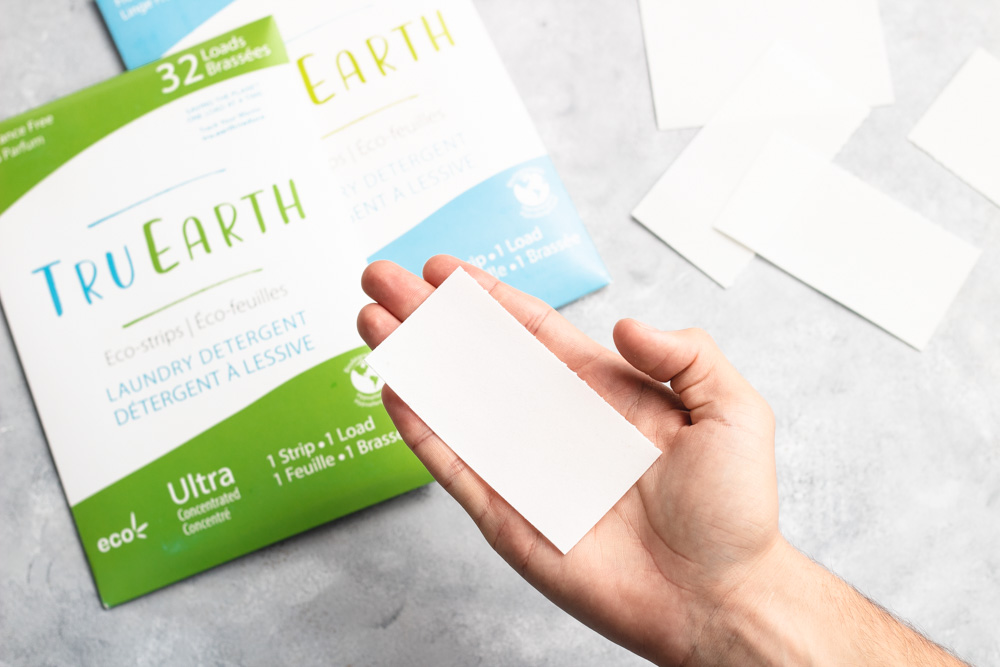
With their laundry strips Tru Earth was able to remove friction on all levels. The strips make doing your laundry easier, with less spilling. They clean just as great (even Ryan himself was skeptical as first), take much less space in your cupboard and they smell great. At the same time people know they create less waste and they’re part of this movement that is eliminating plastic.
INSIGHT
Relentlessly focus on removing all possible friction from buying and using your product so it outperforms the status quo.
2. New micro-jobs of remote warehouse fulfillment
Everybody’s talking about remote working during COVID and how it’s becoming the new normal. That’s mostly related to desk jobs.
During the lockdown, Tru Earth had all of their staff, and people that were having a hard time getting work, do the warehouse fulfillment from their home. They had a van driving to these homes and drop off the stuff that needed to be put together. The next day that truck came back to pick up everything and drop off another set.
New micro-jobs were created that did not exist previously, and while keeping people safe and separated.
INSIGHT
Challenging situations like COVID require you to be creative to maintain business continuity and can spur surprisingly disruptive solutions here to stay.
3. Laundry product with tech problems
Ryan is focusing a lot on the core software features their people need on a day-to-day basis. It allows them to sell and fundraise exactly how they want to.
When you’re using pre-packaged software and you want to be innovative there’s never a perfect solution. It is tempting to use Shopify as main platform and complete it with plugins like ReCharge for subscriptions, templates from Zipify Pages and access control from Locksmith.
It sound perfect, but when you actually implement it, it often turns out plugins don’t play nice together.
INSIGHT
All businesses have tech problems. Mastering technology is an important competence in every type of business. Although pre-packaged software gets you up to speed real quick in the early stages of your business, when you’re looking to grow faster with unconventional ways of selling and fundraising, a custom solution is the only way.
4. Retail is about relationships
To succeed in retail you need quality placement in their stores and this requires mutual exchange. It’s a relationship.
If you can’t give retail the support they need, they are not going to put your product on prominent places because you’re not making them money. If you can’t create awareness for people to go into their store and you’re expecting them to do all the heavy lifting it creates massive dependency on them. If they then decide to stop carrying your product you’re in trouble.
One way Tru Earth does this is by creating localized Facebook Ads and Google Ads using a very small radius around a store stating ‘Now available in this store’. It drives people to that store with an intention to buy, and everybody wins.
INSIGHT
Create win-win partnerships that focus on how you can create more traffic and sales for retail stores, instead of expecting them to shift their existing buyer traffic to your product.
5. Fight a common enemy
As a social brand you need to be careful who to build a relationship with or who they do promotions with.
You can’t say a plastic jug is evil and some naturally sourced vegan protein powder in a plastic jug is not. While it may be ethically sourced and they’re supporting veganism, even though you agree with everything that they’re doing for the most part, the story is different.
So for Tru Earth, because they promote their zero waste plastic-free packaging, any product with a jug made of plastic would fall into their ‘enemy’ category.
Just because somebody has a different story it doesn’t necessarily mean there’s not some sort of synergy. It does mean you can’t do any promotion for that product.
INSIGHT
A challenge for social brands to work together is to define who their specific enemy is. It could be plastic, carbon emission, inequality, harmful chemicals, or anything like that. Any successful business has a common enemy.